
Portugal Travel Guide 2026: The Complete Guide for Indian Travellers

Portugal has a way of catching people off guard.
You arrive expecting a pleasant European holiday — some history, a beach, good wine. What you find instead is a country that feels simultaneously ancient and alive, familiar and entirely itself. Lisbon is built on hills that create viewpoints at every turn, a city where every steep lane reveals something — a tiled facade, a castle wall, a table of old men playing cards outside a café that has been there for fifty years and will be there for fifty more.
Porto is rawer, cooler, built above the Douro river in a tangle of medieval streets where port wine ages in barrel across the water and the light on the rabelo boats in the evening turns everything gold. The Algarve is not just beaches — it is one of Europe's most dramatic coastlines, with limestone cliffs carved into arches and sea caves by the Atlantic, and water the colour of something too blue to name.
For Indian travellers in 2026, Portugal makes a compelling case that is about more than scenery. It is one of the most affordable countries in Western Europe. It is consistently ranked among the safest countries in the world. English is spoken everywhere. And the sheer density of outstanding experiences — across cities, wine country, coast, and island — within a country the size of Indiana is remarkable.
This is the complete Portugal travel guide for Indian travellers in 2026.
Why Portugal in 2026?
In 2025, thirty million tourists visited Portugal — making it one of the most visited countries per capita in Europe. In 2026, it remains one of the continent's most compelling travel destinations — not despite this popularity, but because what the country offers has genuinely earned it.
Portugal offers an exceptional combination of historic cities, Atlantic beaches, volcanic islands, traditional villages, world-renowned wine, celebrated gastronomy, and landscapes shaped by centuries of culture and maritime exploration. It is the country that mapped the world's coastlines in the 15th and 16th centuries, and the confidence and curiosity of that era is still visible in its architecture, its music, and its open hospitality.
For Indian travellers, Portugal has a particular resonance: the shared history of Goa — Portuguese territory for 451 years, until 1961 — creates a cultural thread that makes Portugal feel not entirely foreign. The Indo-Portuguese connections in food, architecture, and vocabulary are genuinely present and genuinely interesting.
And practically: Portugal is notably less expensive than France, Italy, or Spain. A meal at a neighbourhood tasca costs €12–€18 per person with wine. A taxi across Lisbon costs €8. A two-hour train to Porto costs under €30. The same quality of experience available elsewhere in Western Europe costs, at minimum, 30 to 40 percent more.
Portugal Visa for Indian Travellers: What You Need to Know
Portugal is a member of the Schengen Area, meaning Indian passport holders require a Schengen Type C short-stay visa before travel. There is no visa on arrival or e-visa for Indian passports.
The Schengen Tourist Visa:
Valid for stays of up to 90 days within any 180-day period
Covers all 27 Schengen member countries — a Portugal trip can be combined with Spain, France, or any other Schengen country on the same visa
Fee: EUR 90 for adults (~₹8,100), EUR 45 for children aged 6–11
Processing time: 10–15 working days; apply at least 4–6 weeks before travel
Apply through VFS Global Portugal, with centres across India including Mumbai, Delhi, Bengaluru, Chennai, Hyderabad, Kolkata, Ahmedabad, Goa, Chandigarh, Jaipur, Kochi, Pune, and more. Book your appointment at the VFS Global India portal.
Documents required:
Valid Indian passport (minimum 3 months validity beyond intended stay; at least 2 blank pages)
Completed Schengen visa application form
Recent passport-sized photographs to Schengen specifications
Return flight bookings and accommodation confirmations
Travel insurance: minimum EUR 30,000 coverage valid across the Schengen Area for the full duration of stay
Bank statements (last 3 months), salary slips or ITR for self-employed applicants
Important note on ETIAS: ETIAS (European Travel Information and Authorisation System) requires a pre-travel online authorisation from visa-exempt nationalities such as Americans, British, and Australians. Indian passport holders are NOT affected by ETIAS — Indian travellers require a full Schengen visa, which already covers everything ETIAS would cover.
At The Blueberry Trails, complete visa documentation guidance and checklist support are included with every Europe itinerary we design.
Flights from India to Portugal
Portugal's main international gateway is Lisbon Humberto Delgado Airport (LIS). Porto Francisco Sá Carneiro Airport (OPO) is a useful alternative for travellers beginning their journey in the north.
Main route options from India:
Via Doha (Qatar Airways): excellent connections from Mumbai, Delhi, and Bengaluru
Via Dubai (Emirates): well-connected from all major Indian cities
Via Istanbul (Turkish Airlines): popular and often competitively priced
Via Frankfurt or Amsterdam (Lufthansa / KLM): useful for travellers combining a Schengen stopover
Return economy flight estimates (2026):
Departure City | Shoulder Season (Apr–Jun, Sep–Oct) | Peak (Jul–Aug) |
Mumbai (BOM) | ₹65,000 – ₹88,000 | ₹90,000 – ₹1,20,000 |
Delhi (DEL) | ₹62,000 – ₹85,000 | ₹88,000 – ₹1,15,000 |
Bengaluru (BLR) | ₹68,000 – ₹92,000 | ₹92,000 – ₹1,22,000 |
Total travel time: approximately 12–16 hours with one stop.
TBT tip: Flying into Lisbon and out of Porto (or vice versa) eliminates backtracking along the coast and often costs no more than a return to the same city. It is the most logical routing for a first Portugal trip.
Best Time to Visit Portugal from India. Portugal travel guide 2026
Portugal's climate is mild year-round, but the experience varies significantly by season.
Spring — April to June (Recommended) The best overall time for most Indian travellers. Temperatures range from 22–27°C, wildflowers are in full bloom across the Alentejo and Sintra, the Algarve's sea temperature rises from May onwards, crowds are manageable, and accommodation prices are 20–30% below peak summer. This window also aligns with Indian summer school holidays.
Summer — July to August (Peak Season) The hottest, busiest, and most expensive period. Inland areas like Évora can reach 40°C. Lisbon's Alfama is packed. The Algarve beaches are crowded. That said, this is when Portugal is most alive — outdoor concerts, festivals, and an energy that justifies the heat. If you travel in August, book everything 3–4 months ahead.
Autumn — September to October (Excellent) Arguably Portugal's finest season. The summer heat has eased, the Atlantic is still warm enough to swim (24°C in September), the Douro Valley grape harvest begins in September, Lisbon's terraces are still full, and tourist numbers have dropped meaningfully. September is widely considered the best single month for a balanced Portugal itinerary.
Winter — November to March (Quiet and Affordable) Mild compared to most of Europe (10–17°C in Lisbon), significantly cheaper, and without the crowds. Madeira's subtropical climate makes it an excellent winter extension. The Algarve has superb surfing conditions from October through February, particularly at Sagres and Ericeira.
Season | When | What You Get | Consideration |
Spring | Apr–Jun | Best weather, wildflowers, manageable crowds | Book Sintra tickets in advance |
Summer | Jul–Aug | Peak energy, festivals, warm beaches | Highest prices and crowds |
Autumn | Sep–Oct | Harvest season, warm sea, lower prices | Best overall month: September |
Winter | Nov–Mar | Quiet, affordable, great surfing | Some coastal towns quieter |
Where to Go: Portugal's Essential Destinations
Lisbon — Seven Hills, Infinite Character

Lisbon is one of Europe's great capitals — and one of the most walkable. The city spreads across seven hills above the Tagus estuary, creating a landscape of viewpoints (miradouros), steep lanes, and sudden panoramas that reveals itself differently at every hour of the day.
The historic Alfama neighbourhood is the oldest part of the city — a Moorish quarter of narrow, winding streets, laundry strung between buildings, and the kind of lived-in neighbourhood character that most European capitals have long since polished away. It is here that fado — Portugal's hauntingly beautiful musical tradition — is best experienced: in a small casa de fado after 9pm, a singer performing for a room of perhaps thirty people, the mournful guitar beneath them.
Belém, a riverside district west of the city centre, holds the greatest concentration of Portugal's Age of Discovery landmarks: the UNESCO-listed Tower of Belém, the magnificent Jerónimos Monastery, and — most importantly for any food-conscious traveller — the original Pastéis de Belém bakery, where custard tarts have been made to a secret recipe since 1837.
Experiences not to miss:
Tram 28 — the historic yellow tram that winds through Alfama, Graça, and the city's steepest streets. Take it for the ride, not just the transport. Go early to avoid the longest queues.
Miradouro da Graça and Miradouro da Senhora do Monte — the two best viewpoints above Alfama, particularly in the evening when the city glows below and the Tagus turns amber.
LX Factory — a converted industrial complex in the Alcântara neighbourhood, now home to independent restaurants, creative studios, vintage markets, and Lisbon's most atmospheric Sunday market.
Museu Nacional do Azulejo — the national tile museum, dedicated entirely to Portugal's most distinctive art form: the hand-painted azulejo tiles that cover the façades of buildings across the entire country. One of the most unexpectedly rewarding museums in Europe.
Fado at a casa de fado — the experience of hearing fado performed live, in Alfama, at night, is irreplaceable. Go to a traditional house rather than a tourist restaurant for the authentic version.
How many days: Three days minimum. Four is better — Lisbon rewards slow exploration and penalises rushing.
Sintra — A Fairy Tale in the Hills
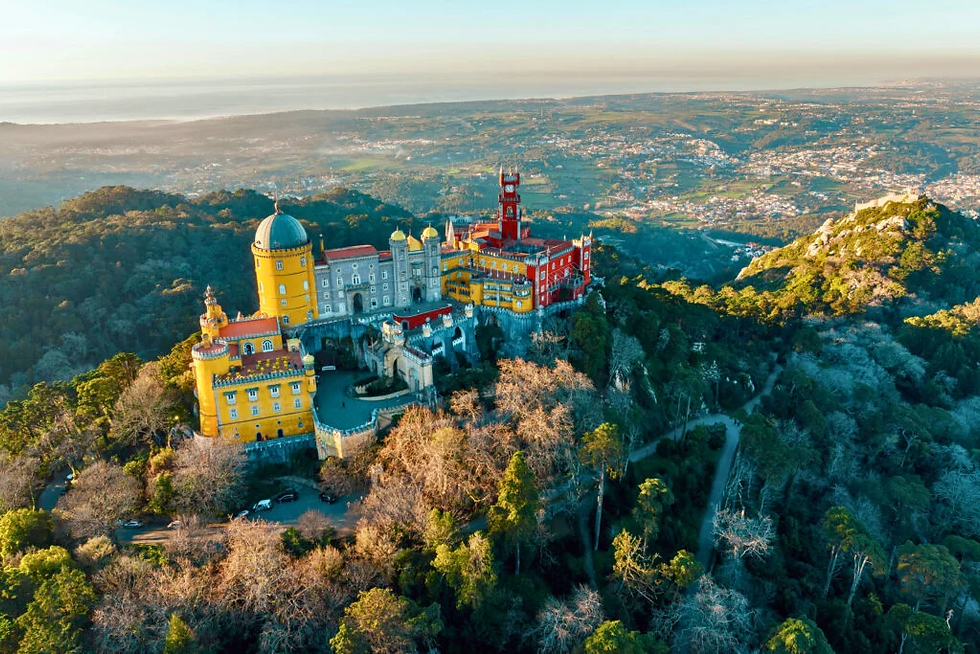
Thirty minutes by train from Lisbon's Rossio station, Sintra is one of the most extraordinarily beautiful places in Europe — and one of the most in-demand. A UNESCO Cultural Landscape since 1995, the forested Serra de Sintra mountains are dotted with palaces, gardens, and estates that the Portuguese royal family built over centuries as their summer retreat.
Pena Palace is the centrepiece — a wildly colourful Romanticist palace perched on a rocky summit, its towers and battlements painted in vivid yellow and red, commanding views over the Atlantic and all the way to Lisbon on clear days. It looks precisely like a fairy-tale palace because it was designed to look like one, built in the 1840s for King Ferdinand II.
Quinta da Regaleira is the more mysterious choice — a Gothic manor house surrounded by gardens designed with Masonic and esoteric symbolism, featuring a 27-metre Initiation Well that descends in a spiral staircase to an underground tunnel network. It is one of the strangest and most compelling places in Portugal.
Practical notes:
Book Pena Palace tickets online in advance — timed entry sells out weeks ahead during summer
Arrive in Sintra town as early as possible — ideally on the first morning train from Lisbon
Allow a full day; trying to see Sintra in a half-day leaves you feeling rushed
The walk between palaces is significant uphill — comfortable shoes are essential
Porto — Wine, Character, and the Douro

Porto is what you discover when you look beyond Lisbon — and many travellers find it the more immediate of the two cities. The UNESCO-listed Ribeira old town descends in a tangle of medieval alleyways to the banks of the Douro river, where the Dom Luís I bridge arches dramatically across to Vila Nova de Gaia — home to all the major port wine lodges.
The city has a rawer, less polished energy than Lisbon. Its tiled buildings are faded and peeling in a way that feels authentic rather than neglected. The food market at Mercado do Bolhão has been restored to its gorgeous early-20th century iron structure. Livraria Lello — one of the world's most beautiful bookshops — has a carved wooden staircase that JK Rowling reportedly drew on when imagining Hogwarts. The street art in the Cedofeita neighbourhood is among the finest public art in Portugal.
And then there is port wine. The lodges across the Douro in Gaia — Graham's, Taylor's, Sandeman, Ramos Pinto — offer tastings and cellar tours that explain, through experience rather than explanation, why this wine has been traded to the world for three hundred years.
Experiences not to miss:
Ribeira and the Dom Luís Bridge — walk across the upper level of the bridge at dusk. The view back to Porto's Ribeira is one of the defining images of Portugal.
Port wine cellar tour and tasting — book a tour at Taylor's Fladgate or Graham's Lodge in Gaia. The cellar atmosphere, the barrels aging in the dark, and the tasting of vintage versus tawny port is a genuinely educational and sensory experience.
Mercado do Bolhão — Porto's restored covered market, magnificent in its restored iron structure, selling local produce, cheeses, smoked meats, fresh fish, and flowers.
Livraria Lello — queue early (the bookshop sells timed tickets). The interior, particularly the carved central staircase, is genuinely extraordinary.
Francesinha — Porto's infamous sandwich: layers of bread, cured meats, steak, and sausage, covered in melted cheese and a spiced tomato-beer sauce, topped with a fried egg. It is the culinary emblem of Porto and worth trying once.
How many days: Two to three days in Porto. Add a Douro Valley day trip or overnight.
Douro Valley — The World's Oldest Wine Region

The Douro Valley is Portugal at its most quietly spectacular. Designated the world's oldest demarcated wine region in 1756, the valley stretches east from Porto for over 100 kilometres — a UNESCO World Heritage landscape of terraced vineyards descending in precise tiers to the Douro river, which winds through it all in long, serpentine curves.
The light on the Douro terraces in the late afternoon — the vines catching golden hour against the river below — is one of the most beautiful wine country scenes in the world. It rivals the Tuscany and Burgundy landscapes that most Indian travellers have on their European wish lists, and it is far less visited.
A river cruise between Régua and Pinhão is one of the most pleasant experiences in Portugal — two hours on the Douro, watching the terraced banks rise and fall, stopping at a quinta (wine estate) for a tasting above the water. September and October bring the vindima (grape harvest), when the valley fills with workers picking by hand and the air smells of fermenting wine.
Getting there: Day trips from Porto take approximately 1.5–2 hours by car, or by the Douro rail line — one of the most scenic train journeys in Europe, running along the riverbank the entire way.
The Algarve — Europe's Most Dramatic Coastline

The Algarve stretches along Portugal's entire southern coast — 200 kilometres of golden limestone cliffs, hidden coves, sea caves carved by the Atlantic, and beaches with water that is, from June through September, warm and extraordinarily clear.
The west Algarve, centred on Lagos and extending to Sagres and the wild Vicentine Coast, is where the landscape is at its most dramatic. Praia da Marinha — a small, cave-flanked cove south of Lagos — is consistently ranked among Europe's most beautiful beaches. The Benagil sea cave, accessible only by boat or kayak, is one of Portugal's most famous images: a vast dome of limestone open to the sky, with a hidden beach inside.
The east Algarve, around Tavira and the Costa Vicentina, is quieter and more unspoiled — a salt marsh landscape of long barrier beaches, flamingoes, and fishing villages that feel untouched by the resort development further west.
For Indian travellers: The Algarve is best visited in June or September when the beaches are warm, uncrowded, and at their most beautiful. July and August are hot, very busy, and significantly more expensive.
Getting there from Lisbon: TAP Portugal operates frequent short flights from Lisbon to Faro (1 hour, from €30 one-way). Alternatively, drive the A2 motorway south in approximately 2.5–3 hours.
Évora — Open-Air Roman Heritage

Évora is a UNESCO World Heritage city that most first-time visitors to Portugal overlook entirely — which is their loss. Located in the Alentejo plains 130 kilometres east of Lisbon, it is one of the best-preserved medieval towns in the Iberian Peninsula, with a complete circuit of Roman walls, a 1st-century Roman Temple standing remarkably intact in the city centre, and the medieval cathedral (Sé) looming above orange-grove squares.
The Alentejo region surrounding Évora is Portugal's wine frontier — producing bold, tannic reds from Alicante Bouschet, Aragonez, and Trincadeira grapes that are becoming increasingly known internationally. Wine estates around Évora offer cellar visits and tastings in landscapes where cork oaks and olive groves alternate across ochre plains.
Évora is ideally placed as a day trip from Lisbon (1.5 hours by direct bus or car) or as an overnight stop on the road south to the Algarve.
Madeira — The Subtropical Island
For travellers with an extra four to five days, Madeira is one of the most rewarding extensions of a Portugal trip. A volcanic island 1,000 kilometres southwest of Lisbon, Madeira has a subtropical climate that means it is green and warm year-round — making it a genuine option even for winter travel.
The island's signature experience is the levada walks — hikes along the ancient irrigation channels (levadas) that carry mountain water down to the coastline, through laurisilva forest, past vertical cliffs, and along paths that sometimes require you to wade through mountain tunnels. The Pico Ruivo sunrise hike — up to Portugal's third highest peak above the cloud line — is one of the most memorable morning walks in Europe.
The natural lava pools at Porto Moniz on the island's northwest tip are one of Madeira's most loved swimming experiences — volcanic rock formations naturally filled by the Atlantic.
What to Eat in Portugal: A Guide for Indian Travellers
Portuguese cuisine is built on simplicity, quality ingredients, and the distinctive maritime flavours of a culture that has lived by the Atlantic for centuries.

Pastéis de Nata — custard tarts with a caramelised, slightly blistered top in a shattering flaky pastry shell, dusted with cinnamon. The original recipe belongs to the Pastéis de Belém bakery in Lisbon. They are best eaten warm, standing up, from a paper bag. They are the most important thing to eat in Portugal.
Bacalhau (Salt Cod) — Portugal's national ingredient, consumed in reportedly 365 different recipes (one for every day of the year). Bacalhau à Brás — shredded salt cod with scrambled eggs, potatoes, and olives — is the most accessible version for Indian palates.
Francesinha — Porto's legendary sandwich: layers of bread, ham, sausage, and steak covered in melted cheese and a spiced tomato-beer sauce, topped with a fried egg. Rich, aggressive, and completely unlike anything else.
Grilled sardines (Sardinhas assadas) — particularly during June's Festas dos Santos Populares in Lisbon, when the entire city smells of grilling sardines. Simple, fresh, and extraordinary.
Alheira — a smoked sausage made with poultry and bread, originating from the Jewish communities of northern Portugal who needed to appear to be eating pork. One of the more unusual and compelling food stories in European cuisine.
Caldo Verde — a simple, warming soup of potato, kale, and chouriço sausage. Portugal's most comforting dish, available everywhere.
Port wine — aged in oak barrels in the lodges of Vila Nova de Gaia opposite Porto. Tawny port (nutty, orange-hued, aged in smaller barrels) and LBV Vintage port are the two most important styles for first-time tasters.
Ginjinha — a sour cherry liqueur served in a tiny ceramic cup or a chocolate cup, sold from hole-in-the-wall shops in central Lisbon. At €1.50 a shot, it is one of travel's genuine bargains.
For vegetarians: Lisbon and Porto have excellent vegetarian restaurants — DaTerra in Porto (a pay-by-weight vegetarian buffet) is particularly recommended. Most traditional restaurants offer vegetable soups, cheese boards, egg dishes, salads, and bread with quality olive oil. Pastéis de nata are vegetarian. The further you travel from cities, the more limited options become — carry a translated dietary requirements card for rural areas.
Getting Around Portugal
Train: Portugal's CP rail network connects Lisbon, Porto, Sintra, Évora, and most major towns efficiently. The Alfa Pendular high-speed train covers Lisbon–Porto in approximately 3 hours. The Douro Line from Porto east along the river is one of Europe's most scenic rail journeys. Buy tickets at CP.pt.
Bus: Rede Expressos and FlixBus cover routes the train does not, including Algarve coastal towns. Comfortable and inexpensive.
Rental car: Essential for the Algarve's coastal clifftops, the Douro Valley's quintas, and the Alentejo's cork oak plains — none of which are adequately served by public transport. Roads are excellent. Petrol stations are plentiful on major routes.
Lisbon Metro and Trams: Lisbon's metro covers major districts efficiently. Trams cover the hillier areas — Tram 28 is iconic but crowded; use it as an experience rather than transport.
Domestic flights: TAP Portugal operates frequent short flights Lisbon–Faro (Algarve) from €30 one-way. Flying saves 3 hours versus driving. Madeira is served by multiple daily flights from Lisbon (1.5 hours).
Taxis and apps: Bolt and Free Now are the ride-hailing apps used in Portugal. Both are reliable and significantly cheaper than London or Paris taxis.
Practical Travel Tips for Indians Visiting Portugal
Currency: Euro (€). Cards are accepted almost everywhere in Lisbon and Porto. Smaller towns, local markets, and some traditional restaurants prefer cash. Keep €50–€100 in cash for these situations. ATMs (Multibanco) are everywhere and charge no withdrawal fee on the Portuguese side.
Language: Portuguese. Crucially, Portuguese is not Spanish — locals notice and deeply appreciate the distinction. A few phrases go a long way: Bom dia (good morning), Obrigado / Obrigada (thank you — male / female speaker), Por favor (please), Com licença (excuse me). English is widely spoken in tourist areas, especially by anyone under 40.
Safety: Portugal ranked third globally in the 2024 Global Peace Index — it is one of the safest countries in the world for tourists, including solo women travellers. Standard urban precautions apply in crowded Lisbon trams and Porto metro stations for pickpocketing.
SIM card: MEO, Vodafone PT, and NOS sell tourist SIMs at Lisbon and Porto airports. Approximately €10–€15 for 10–15GB data. eSIMs from Airalo and Holafly offer Portugal plans from €5.
Booking in advance: Book Pena Palace Sintra and Quinta da Regaleira timed-entry tickets at least 3 weeks ahead for summer travel. Port wine cellar tours (Taylor's, Graham's) fill quickly in September and October. Douro Valley quintas require advance reservation.
Hills: Both Lisbon and Porto are seriously hilly — cobblestoned slopes that look gentle on a map and feel very different in practice. Comfortable walking shoes are not optional. Rolling luggage on Lisbon's cobblestones is an experience best avoided.
Sunday: Some traditional tascas and smaller shops close on Sundays. Major supermarkets (Pingo Doce, Continente, Lidl) remain open.
How Much Does a Portugal Trip Cost from India?
Portugal is one of the most affordable Western European destinations. Daily costs on the ground run approximately ₹8,000–₹12,000 per person — significantly lower than France, Italy, or Spain.
Expense | Budget | Mid-Range | Premium |
Return flights (economy) | ₹62,000 – ₹75,000 | ₹75,000 – ₹95,000 | ₹1,20,000+ |
Schengen visa + insurance | ₹10,000 – ₹13,000 | ₹10,000 – ₹13,000 | ₹10,000 – ₹13,000 |
Accommodation (10 nights) | ₹25,000 – ₹40,000 | ₹50,000 – ₹90,000 | ₹1,20,000+ |
Food (10 days) | ₹14,000 – ₹22,000 | ₹25,000 – ₹40,000 | ₹55,000+ |
Transport (trains, buses) | ₹8,000 – ₹12,000 | ₹12,000 – ₹18,000 | ₹20,000+ |
Activities + entry fees | ₹6,000 – ₹12,000 | ₹14,000 – ₹22,000 | ₹35,000+ |
Shopping + miscellaneous | ₹5,000 – ₹10,000 | ₹12,000 – ₹20,000 | ₹40,000+ |
TOTAL (per person, 10 days) | ~₹1,30,000 | ~₹2,00,000–₹2,50,000 | ~₹4,00,000+ |
Shoulder season (April–June or September–October) reduces flights and accommodation by 20–30% compared to peak summer. Couples splitting accommodation and transport costs save significantly on the per-person total.
A Suggested 10-Day Portugal Itinerary
This is how we structure a well-paced first Portugal journey at The Blueberry Trails:
Day | Location | Highlights |
Day 1 | Arrive Lisbon | Settle in, Miradouro da Graça sunset, evening in Alfama |
Day 2 | Lisbon | Belém Tower, Jerónimos Monastery, Pastéis de Belém, LX Factory evening |
Day 3 | Lisbon | Alfama on foot, Museu do Azulejo, fado evening |
Day 4 | Sintra day trip | Pena Palace, Quinta da Regaleira, return to Lisbon for dinner |
Day 5 | Lisbon → Porto | Train north, arrive Porto for Ribeira evening walk |
Day 6 | Porto | Livraria Lello, Mercado do Bolhão, port wine tasting in Gaia |
Day 7 | Douro Valley | Day trip by train or car — river cruise, quinta tasting, scenic return |
Day 8 | Porto → Algarve | Fly or drive south, arrive Lagos or Albufeira |
Day 9 | Algarve | Benagil cave boat trip, Praia da Marinha, Sagres sunset |
Day 10 | Algarve → Depart | Morning beach, drive or fly to Lisbon for onward flight |
This itinerary flows north to south — logical, scenic, and without backtracking. A rental car from Porto onwards gives maximum Douro and Algarve flexibility.
The TBT Perspective on Portugal
Portugal is a country that does not ask to be loved — and is loved immediately for it.
There is no performance here of the kind you sometimes find in more heavily touristed European cities. The tascas serve what they have always served. The fado singers perform because the music demands it, not because a tourist is watching. The fishermen at Nazaré still mend nets on the beach the morning after the big waves break.
And in the quiet moments — a pastel de nata eaten warm above the Tagus, the light going amber on the Douro terraces, the sound of a guitar beginning in a courtyard in Alfama at 10pm — Portugal reveals itself to be something genuinely rare: a country that has not been performing for tourists long enough to forget what it actually is.
At The Blueberry Trails, our Portugal itineraries are built for Indian travellers who want exactly that — the real country, in the right order, with the right amount of time in each place to feel it rather than photograph it and move on.

Frequently Asked Questions
Do Indian passport holders need a visa for Portugal? Yes. Portugal is part of the Schengen Area. Indian passport holders require a Schengen Type C tourist visa applied for through VFS Global. The fee is EUR 90. Apply at least 4–6 weeks before travel. The visa covers all 27 Schengen countries.
What is the best time to visit Portugal from India? April to June and September to October — warm weather, manageable crowds, and prices 20–30% below peak summer. September is the single best month: warm sea, harvest season in the Douro, and the summer crowds have eased.
How many days do I need for Portugal? Seven days covers Lisbon, Sintra, and Porto. Ten days adds the Algarve for a complete first Portugal experience. Fourteen days allows for Évora and Madeira.
Is Portugal good for vegetarians? Yes, particularly in Lisbon and Porto which have strong vegetarian restaurant scenes. DaTerra in Porto is highly recommended. Traditional restaurants have soups, salads, egg dishes, and cheese as reliable options. Carry a dietary requirements card for rural areas.
What should I not miss in Portugal? Pastéis de nata from Pastéis de Belém in Lisbon. Fado in Alfama. Pena Palace in Sintra. The Douro Valley by train. Port wine tasting in Gaia. A Benagil cave boat trip in the Algarve. The Dom Luís Bridge at dusk from Porto.
Is Portugal safe for Indian travellers? Yes — Portugal consistently ranks among the world's safest countries. Violent crime is extremely rare. Standard precautions against pickpocketing in crowded tourist areas apply.
Plan Your Portugal Journey With The Blueberry Trails
Portugal is the kind of destination that rewards the traveller who arrives without a strict agenda — and punishes the one who tries to see everything in five days. The right itinerary gives each place the time it deserves: Lisbon three mornings, Sintra a full day, Porto evenings on the Ribeira, one slow afternoon in a Douro quinta watching the river below.
That is how we design Portugal. And we would love to design yours.
Explore our Europe Holiday Packages
The Blueberry Trails is a Mumbai-based curated travel company designing international holiday packages for Indian travellers from Mumbai, Delhi, and Bengaluru. Every journey is built around the traveller — not a template.


Comments