
Italy Holiday from India: The Complete Travel Guide for 2026

Italy has a quality that is almost unfair. It is beautiful in a way that feels effortless — as though the country has never had to try particularly hard at it. Ancient ruins stand in the middle of functioning cities. Renaissance paintings hang in churches that were never intended as museums. The best meal you have ever eaten happens, entirely without warning, at a table with a paper tablecloth in a room where the menu was handwritten that morning.
For Indian travellers, Italy is a destination that tends to exceed expectations even when those expectations are already high. The history is accessible in a way that no amount of reading fully prepares you for — you round a corner in Rome and find yourself standing in front of the Pantheon, which has been standing in more or less this exact form since 125 AD. The food rewards curiosity and patience rather than a reservation at the most talked-about restaurant. And the landscape, from the Dolomites in the north to the Amalfi Coast in the south, is consistently extraordinary.
This guide is designed to help you plan your Italy holiday from India — the best regions, the right time to travel, how to get there, and how to build an itinerary that gives Italy the space it deserves.

Understanding Italy: A Country of Regions
Italy's greatest strength as a travel destination is also its greatest planning challenge: no two parts of the country feel alike. Each region has its own dialect, its own cuisine, its own pace, and its own very clear opinion about how life should be lived.
Understanding this before you plan prevents the most common Italy mistake: treating it as a single destination to be covered rather than a collection of distinct worlds to be chosen between.
Rome
Rome is not a city so much as a living museum that insists on being a city at the same time. The Colosseum, the Forum, the Pantheon, the Vatican — these are not just sights. They are physical evidence of a civilisation that shaped the modern world, and they are still here, still standing, still capable of producing genuine awe in even the most seasoned traveller.
But Rome is also a city of neighbourhoods. Trastevere, with its cobbled lanes and ivy-covered buildings, feels like a village within the metropolis. Testaccio is where Roman food — offal dishes, suppli, cacio e pepe in its most authentic form — is taken most seriously. Pigneto and Prati are where the city lives when it is not performing for tourists.
Allow three full days minimum. Rome does not reward rushing.

Florence and Tuscany
Florence is the Renaissance made physical. The Uffizi Gallery, the Accademia (home to Michelangelo's David), the Duomo's extraordinary dome — the concentration of art and architecture in this small city is almost bewildering. It is also, in peak season, extremely busy, which makes the timing and pacing of a Florence visit particularly worth thinking through.
Beyond the city, Tuscany is one of the finest landscapes in Europe: rolling hills planted with cypress and olive, hilltop towns like Siena, San Gimignano, and Montepulciano, and a wine and food culture centred on Chianti that has been refined over centuries. A self-drive through the Tuscan countryside — with two or three nights in an agriturismo — is one of Italy's most rewarding experiences and one that we build into many TBT itineraries.

the Amalfi Coast
South of Naples, the Amalfi Coast is perhaps Italy's most dramatically beautiful stretch of coastline — a sequence of clifftop villages clinging to vertiginous slopes above the Tyrrhenian Sea. Positano is the most photographed, its pastel-coloured buildings cascading from the cliff to the water. Ravello, higher up, is quieter and more refined. Amalfi itself has a cathedral that surprises with its grandeur.
The coast is best experienced slowly. The road is famously narrow and dramatic, the villages are connected by ferry as well as road, and the quality of the seafood — particularly in the smaller, less tourist-facing restaurants — is exceptional.
Pair Amalfi with a night or two in Naples beforehand. The city is rough around the edges and all the better for it: the pizza (Naples invented it and has never been surpassed), the street food, the National Archaeological Museum with its extraordinary collection from Pompeii — Naples rewards those willing to look past its surface.
Venice
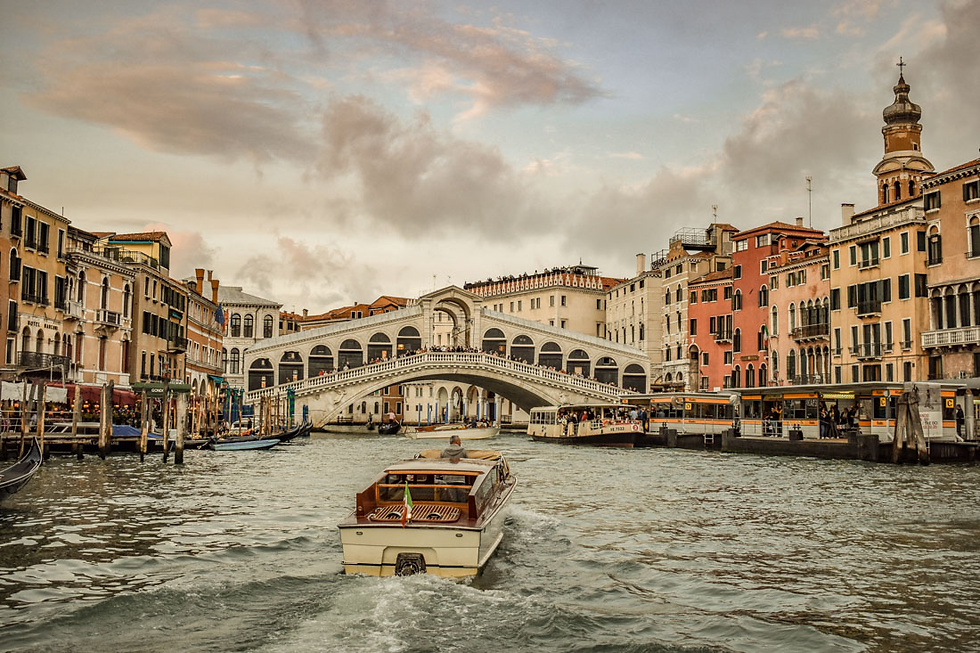
There is no city on earth that looks like Venice, and this is both its greatest appeal and its most significant challenge. Venice is genuinely unique — a medieval city built on water, its Gothic palaces reflected in canals, its streets navigated entirely on foot or by boat. It is also, in peak season, almost overwhelmed by its own fame.
The solution is to visit early or late in the day, to stay overnight rather than arriving as a day tripper, and to find your way into the quieter sestieri — Cannaregio, Castello, Dorsoduro — where the city lives when it is not performing. A morning spent getting lost in Venice, without a map or a destination, is one of the finest travel experiences available in Europe.

The Dolomites and Northern Italy
For travellers who want Italy to feel genuinely unexpected, the Dolomites deliver it. These jagged limestone peaks in the northeast of the country are among the most spectacular mountain landscapes in Europe — a UNESCO World Heritage Site that is dramatically different from every other part of Italy. Summer brings hiking trails and alpine meadows. Winter brings some of the best skiing in the Alps.
The lakes of northern Italy — Como, Maggiore, Garda — offer a different kind of beauty: grand villas and manicured gardens on the shores of deep, glacially carved lakes, backed by Alps. Lake Como in particular has attracted writers, artists, and travellers for centuries, and its appeal remains entirely intact.
Dont Miss: The Top Travel Destinations for 2026

Best Time to Visit Italy from India
Italy is a year-round destination, but the timing makes a significant difference to the experience.
April to June is the finest overall window. The weather is warm and reliable, the light is beautiful, flowers are in bloom across Tuscany and the Amalfi Coast, and the crowds — while present — have not yet reached peak summer intensity. This is the window most recommended for first-time visitors.
July and August are peak season: hot, busy, and expensive, particularly in Rome, Florence, and the Amalfi Coast. If travelling in summer, book everything well in advance and consider starting early in the day to avoid the worst of both the heat and the crowds.
September and October rival spring for appeal. The heat softens, the summer crowds thin, the harvests begin in Tuscany (September is grape harvest season, October is olive harvest), and the country settles into a pace that feels more genuinely Italian. Arguably the finest time to visit if a Tuscany itinerary is involved.
November to March is low season in most of southern and central Italy, with shorter opening hours and some coastal businesses closed. Rome and Florence remain worthwhile year-round, and the Dolomites in winter are exceptional for skiing.
For Indian travellers: April–June and September–October offer the strongest combination of weather, experience, and manageability.

How to Reach Italy from India
Italy's main international gateway for most itineraries is Rome Fiumicino (FCO). Milan Malpensa (MXP) is the better entry point for northern Italy itineraries including the Lakes and Dolomites.
Common connections from India: Emirates via Dubai, Etihad via Abu Dhabi, Qatar Airways via Doha, and Lufthansa via Frankfurt are among the most consistent options. Air India operates direct flights between Delhi and Rome seasonally. [VERIFY direct flight availability before publishing.]
Flight time: Approximately 10–14 hours with one stop depending on the hub.
Visa for Indian passport holders: Italy is part of the Schengen Area. Indian travellers require a Schengen tourist visa, applied for through the VFS Italy Visa Application Centre. Applications should be submitted four to six weeks before travel. [VERIFY current Schengen visa fee and documentation requirements before publishing.]
Getting around Italy: Italy's rail network is excellent and connects the major cities efficiently. The high-speed Frecciarossa trains between Rome, Florence, and Milan are fast, comfortable, and well worth using. For Tuscany and rural areas, a hire car is the most practical option and opens up the countryside considerably.

A Sample Italy Itinerary from India (10 Nights)
Day 1–3: Rome Arrive and allow the first evening to settle. Day two for the ancient city: the Colosseum, the Forum, and the Palatine Hill in the morning; the Pantheon and Piazza Navona in the afternoon; dinner in Trastevere. Day three for the Vatican and the afternoon for neighbourhood exploration — Testaccio for the food market, a long early evening aperitivo somewhere with a view.
Day 4–5: Florence High-speed train from Rome (1.5 hours). Two days for the Renaissance: the Uffizi on day one (book in advance), the Duomo and Accademia on day two. Evenings in the Oltrarno neighbourhood across the river, which has a quieter, less tourist-facing character than central Florence.
Day 6–7: Tuscany Hire a car in Florence and drive into the countryside. Two nights in a Chianti agriturismo, with time for Siena and San Gimignano woven into the route. Wine tasting, long lunches, and the particular pleasure of Tuscan roads at their own pace.
Day 8: Naples Return car to Florence, train to Naples. An afternoon and evening for pizza, street food, and the energy of the city.
Day 9–10: Amalfi Coast Two days on the coast: Positano, Ravello, Amalfi. Move between villages by ferry where possible — it is significantly more pleasant than the road. A boat trip along the coastline, seen from the water, makes the scale of it properly comprehensible.
Day 11: Depart from Naples (NAP)
Also Read: 10 Unforgettable Things to Do in Iceland in Summer – A Curated Guide to Luxury Travel Experiences

Italy Holiday Budget from India
Category | Budget Range (Per Couple) |
Return flights from India (economy) | ₹70,000 – ₹1,30,000 |
Return flights from India (business) | ₹2,50,000 – ₹4,00,000 |
Accommodation (mid-range, 10 nights) | ₹1,20,000 – ₹2,00,000 |
Accommodation (boutique/luxury, 10 nights) | ₹2,50,000 – ₹5,00,000+ |
Rail passes and internal travel | ₹20,000 – ₹40,000 |
Meals (per day, per couple) | ₹5,000 – ₹12,000 |
Activities, museum entries, experiences | ₹15,000 – ₹35,000 |
Visa fees (Schengen, per person) | ₹7,500 – ₹9,000 |
Estimated Total (mid-range) | ₹4,00,000 – ₹6,00,000 |
Estimated Total (luxury) | ₹8,00,000 – ₹14,00,000+ |
Note: All figures are approximate. [VERIFY current Schengen visa fee before publishing.]

Practical Tips for Your Italy Holiday
Book the major museums in advance. The Uffizi, the Vatican Museums, and the Colosseum all sell out well ahead in peak season. Arriving without a booking means queueing for hours or missing them entirely. Pre-booking is not optional during April–September.
Eat where the Italians eat. The restaurants immediately adjacent to major tourist sights are almost universally poor value. Walk two streets away and the quality and price improve considerably. Lunch at a local trattoria — a fixed-price menù del giorno — is one of the best-value eating experiences in Europe.
Learn the coffee culture. Italians drink espresso standing at the bar, and they drink it quickly. Ordering a cappuccino after midday marks you immediately as a tourist — which is fine, but understanding the rhythm of Italian coffee culture is one of the small pleasures of being there.
Travel between cities by train where possible. Italy's high-speed rail is excellent, reliable, and far more pleasant than flying between cities. The Rome–Florence–Milan corridor is particularly well served.
Respect the dress codes at religious sites. Shoulders and knees must be covered when entering churches and the Vatican. Carry a scarf or light layer — it is genuinely enforced.
Also Read: 10 Beautiful Scandinavian Cities

Why Plan Your Italy Holiday with The Blueberry Trails
Italy is one of the world's great travel destinations — and one of the easiest to experience superficially. The travellers who leave Italy most deeply affected are those who chose their regions carefully, gave each place enough time, and found their way to the version of it that exists beyond the obvious.
At The Blueberry Trails, we design Italy itineraries around the traveller first. Whether you are drawn to history, food, landscape, or art — or some particular combination of all four — we build journeys that connect you to the Italy you are actually looking for.
If you are beginning to plan your Italy holiday, we would love to be part of that conversation.
Exploring other destinations? Read our guides to Greece Holiday from India, Switzerland Holiday from India, and Japan Holiday from India — or browse the full TBT destination collection.


Comments