
Rare Dining Experiences Worth Flying For: 8 Nordic Restaurants That Define Destination Dining in 2026

What if dinner wasn't just part of the journey — but the reason for taking it?
It is not a new idea. People have always travelled for food — for a dish they read about, a market they wanted to walk through, a wine region they wanted to understand by standing inside it rather than reading about it. But what is relatively new is a generation of restaurants that are not simply places to eat well in a city you are already visiting. They are destinations in their own right. Places where the architecture, the landscape, the philosophy, and the food combine into an experience that cannot be separated from the specific place in which it exists.
Nowhere in the world is doing this more ambitiously or more beautifully right now than the Nordic countries. From Norway's coastline to the Faroe Islands' remote cliffs, from Iceland's volcanic lava fields to the floating rivers of Swedish Lapland, a remarkable collection of restaurants have emerged in the last decade that challenge what a meal can be — and in doing so, have become some of the most compelling reasons to travel.
At The Blueberry Trails, we believe the best journeys are often organised around experiences that cannot be replicated elsewhere. These restaurants are precisely that.
Here are eight of them.
Under — Norway
Dining Beneath the Norwegian Sea

Built dramatically into the southernmost tip of the Norwegian coastline at Lindesnes, Under is Europe's first underwater restaurant — and one of the most extraordinary dining environments anywhere in the world.
The name is deliberately double: in Norwegian, under means both "below" and "wonder." Both meanings apply.
The building itself is a feat of architecture and engineering: a 34-metre concrete tube inclined into the sea, one end resting on the seabed five metres below the surface. At its base, a panoramic window — eleven metres wide and 3.4 metres tall — looks directly into the marine world of the North Sea. Guests seated before it dine with a live, constantly changing view of the sea floor: fish moving through the current, anemones, kelp, and the particular deep-blue quality of northern water light.
The kitchen works with the marine ecosystem surrounding the building — seasonal Norwegian seafood, shoreline plants, and tidal-zone ingredients gathered in the tradition of Nordic foraging. A dinner at Under is typically a multi-course tasting menu that moves between the dramatic and the intimate, always anchored by what is immediately outside the glass.
Tables at Under book out months in advance. When planning a Norway itinerary, the restaurant is located near the village of Båly, approximately 150 kilometres south-west of Kristiansand — best reached by car, which itself becomes a scenic coastal drive through one of Norway's quieter and more beautiful coastlines.
To book: underrestaurant.no — reservations open 6 months ahead.
Alchemist — Copenhagen, Denmark
The Meal as Total Experience

There are restaurants that serve extraordinary food. And then there is Alchemist, which has concluded that the very concept of a restaurant is too limiting.
Rasmus Munk's Copenhagen restaurant is not simply a dining experience. It is a five-act performance that unfolds over 50 courses (grouped into small bites, main courses, and desserts) across an evening that typically lasts four to five hours, moving through a series of spaces each designed with specific artistic intention.
The centrepiece is the Dome: a 1,000-square-metre sphere onto which immersive visual installations are projected as guests dine, creating a theatrical backdrop that shifts between the Northern Lights, oceanic depths, political imagery, and abstract visual art. The kitchen's creative philosophy addresses what Munk calls "holistic cuisine" — food that engages not just taste but emotion, consciousness, and social awareness.
Alchemist holds two Michelin stars and has been consistently ranked among the world's 50 best restaurants. It is also, almost inevitably, one of the hardest reservations to secure in the world — a table for two typically costs DKK 4,500–5,500 (approximately Rs 50,000–60,000) for the evening, excluding drinks.
For travellers visiting Copenhagen — one of the world's great cities at any time, but particularly beautiful in late spring and early autumn — an Alchemist reservation anchors an itinerary around an experience that is genuinely unlike anything else in dining.
To book: alchemist.dk — reservations open several months ahead; joining the waiting list is strongly recommended.
Löyly — Helsinki, Finland
Finnish Design, Sauna Ritual, and the Baltic Sea

If Alchemist challenges everything a restaurant can be, Löyly is something more quietly radical: a reminder that an experience rooted in simplicity and a deep sense of place can be as extraordinary as any elaborate production.
Löyly occupies a striking wooden building on Helsinki's waterfront — a cascading structure of slatted timber designed by Avanto Architects that steps down to the sea like a natural landform. The building houses a restaurant, three saunas, and a series of outdoor terraces where guests bathe, eat, and look out across the Helsinki archipelago.
The sauna — the Finnish word for which has no precise equivalent in other languages, because the concept it describes is uniquely Finnish — is not merely a hot room here. It is a cultural and social ritual, practised by Finns in ways that reflect values of simplicity, honesty, and connection. Löyly brings this ritual into a contemporary design context without diluting it.
The restaurant's menu reflects the same sensibility: Finnish ingredients, clean preparation, an honest relationship with the Nordic seasons. Dining here after an hour in the sauna, looking out at the Baltic in the evening light, is exactly as good as it sounds.
Getting there: Löyly is easily reached from central Helsinki. Helsinki itself is a 3-hour flight from London (via SAS, Finnair, or British Airways), making it a highly accessible addition to a Nordic itinerary.
Iris — Norway
The Floating Restaurant on Norwegian Waters

The journey to Iris begins before you arrive. Reaching this floating restaurant on a Norwegian fjord requires a boat transfer — a short crossing that leaves the mainland behind and deposits you at what can only be described as a sculpture that also happens to serve dinner.
The building is extraordinary: a polished silver disc form, perhaps 30 metres in diameter, floating on the fjord and accessed by a narrow gangway. Its reflective exterior mirrors the water, the mountains, and the sky — disappearing into the landscape in the way that truly considered architecture sometimes does.
Inside, the dining room is intimate and focused entirely outward — floor-to-ceiling glass bringing the fjord landscape into the room. The kitchen works with local Norwegian produce and seafood, and the menu changes with the seasons in direct response to what the surrounding landscape and waters provide.
The remote location makes getting there part of the experience — which is entirely by design. Iris is not a restaurant you stumble upon. It requires commitment. And that commitment shapes how you feel when you sit down at the table.
Also Read: The Most Extraordinary Hotels in Iceland
Moss Restaurant — Iceland
Where Volcanic Landscape Meets Icelandic Cuisine

Set inside The Retreat at Blue Lagoon — the extraordinary subterranean luxury hotel built into an 800-year-old lava field — Moss is Iceland's most celebrated fine dining restaurant and one of the most singularly situated tables in the world.
The dining room looks directly onto the Blue Lagoon's milky geothermal water and the surrounding volcanic lava landscape through floor-to-ceiling glass. It is a view of Iceland's most elemental self — raw, extraordinary, and humbling in a way that few restaurant settings manage.
The kitchen's approach is rooted in Iceland's own remarkable larder: Arctic char, langoustine, lamb from highland farms, skyr, wild herbs gathered from the volcanic terrain, and the extraordinary produce that Iceland's geothermal energy makes possible — year-round greenhouses that supply the restaurant with fresh vegetables regardless of season.
Moss received a Michelin Green Star for its sustainability credentials in 2022 and has maintained it since — a recognition of a genuine commitment to operating in harmony with the extraordinary environment that surrounds it.
For travellers visiting Iceland, a reservation at Moss is the perfect way to conclude a day at the Blue Lagoon — or to experience The Retreat as a hotel guest, with priority access to the private lagoon section.
To book: bluelagoon.com — reservation essential; popular dates book out 2–3 months ahead.
Arctic Bath — Swedish Lapland
The River, the Forest, and the Northern Sky

In the village of Harads in Swedish Lapland, floating on the dark, cold water of the Lule River, Arctic Bath offers something that almost no other dining destination can: the experience of being completely surrounded by the northern wilderness, with the river moving gently beneath you and — between late September and mid-March — the real possibility of the aurora borealis appearing overhead as you eat.
The hotel and spa is built around the relationship between people and the northern landscape. Guests stay in riverside cabins or floating rooms, use the outdoor saunas, swim in the river's cold embrace, and eat in a restaurant that reflects the character of the place — Nordic ingredients, honest cooking, a warmth that is necessary when the temperature outside is -20°C.
Arctic Bath is simultaneously a hotel, a wellness experience, a dining destination, and a Northern Lights viewing platform — a combination of experiences that makes it one of the most compelling single-destination stays in Northern Europe.
Getting there: Fly to Luleå Airport in northern Sweden, then 1 hour by car or pre-arranged transfer to Harads.
180 Degrees — Tallinn, Estonia
Contemporary Estonian Cuisine in the Baltic's Most Beautiful Old Town

Tallinn's medieval Old Town is one of the most intact in Northern Europe — a UNESCO-listed walled city of Gothic spires, cobbled squares, and merchant houses that have stood largely unchanged for five centuries. Within this extraordinary setting, 180 Degrees is Tallinn's most compelling contemporary dining experience.
The restaurant takes its name from its panoramic terrace view across the Old Town rooftops and the Baltic beyond. But the food is the real reason to be here: a menu that takes contemporary Estonian cuisine seriously — Baltic seafood, wild mushrooms, game, fermented dairy, and seasonal forage, prepared with technical precision and a genuine sense of place.
For travellers who tend to route their European itineraries through the same cities every time, Tallinn is a revelation. The Old Town, the digital-forward city culture, the compactness of the centre, and restaurants like 180 Degrees make it one of Europe's most compelling and underrated short-break destinations.
Áarstova — Tórshavn, Faroe Islands
A Timber House, A Table, and Four Hundred Years of Faroese Tradition

Among the most photographed buildings in Tórshavn — the Faroe Islands' small, striking capital — is a dark timber house with a grass roof that has stood on a cobblestoned lane since the 17th century. Inside it, Áarstova offers what might be the most atmospheric dining room in the North Atlantic.
The restaurant specialises in traditional Faroese cuisine: dishes that have been shaped by centuries of isolation, resourcefulness, and the particular ingredients available on a volcanic archipelago in the middle of the ocean. Fermented lamb (skerpikjøt), dried fish, local potatoes, Faroese cheeses, and ocean-fresh seafood are prepared and presented in ways that feel less like fine dining and more like being invited to eat by someone who deeply understands their own heritage.
The atmosphere — low ceilings, candlelight, timber that has absorbed centuries of smoke and sea air — is unlike anywhere else. A dinner at Áarstova is as much about where you are as what you eat.
Koks — Faroe Islands
The Remote Islands' Most Celebrated Table
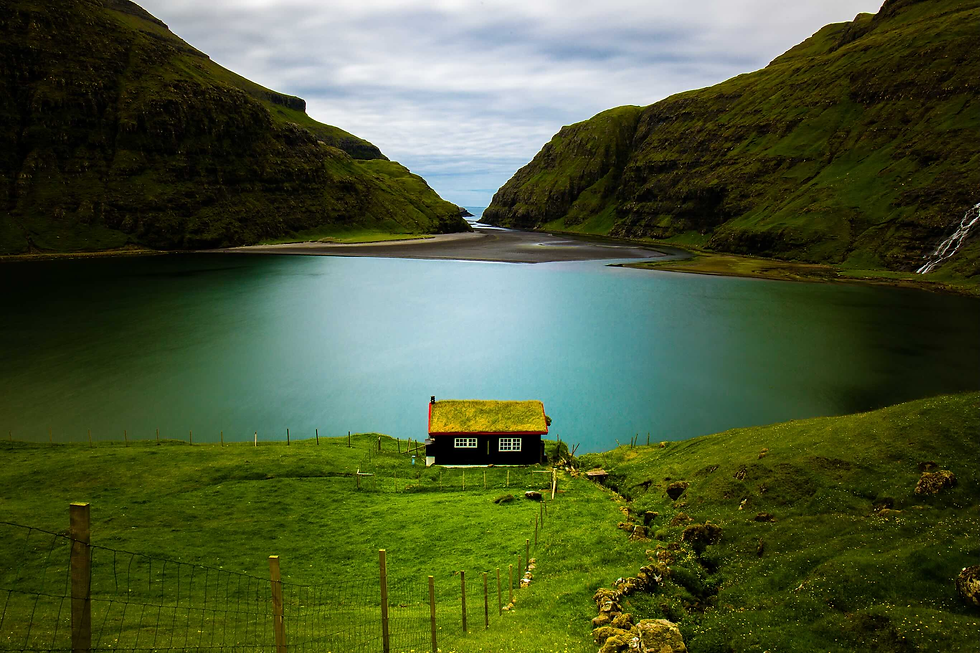
If any restaurant on this list has done more to put a remote destination on the world's travel map, it is Koks.
The Faroe Islands — eighteen volcanic islands suspended in the North Atlantic between Norway and Iceland, with a population of only 54,000 — were largely unknown to international travellers when Koks began attracting global food media attention in the mid-2010s. They are no longer unknown. Koks — currently holding two Michelin stars — has become one of the world's most sought-after dinner reservations, and the journey to reach it has become, for many travellers, as meaningful as the meal itself.
The restaurant's philosophy is entirely shaped by the place. Faroese culinary heritage is built on preservation — the island's harsh climate and geographic isolation required techniques of salting, fermenting, and wind-drying that have been practised for centuries. Koks treats these traditions not as historical curiosities but as living culinary languages: lamb aged in the traditional ræst (wind-dried) method, sea urchins gathered from the fjord below, guillemot eggs, skerpikjøt, and ingredients foraged from the hillsides that surround the restaurant's remote location.
A dinner at Koks typically runs to around 17 courses and takes three to four hours. The experience is quiet, focused, and profoundly connected to its landscape — the opposite of spectacle, and all the more extraordinary for it.
Getting there: Fly to Vágar Airport in the Faroe Islands, served by Atlantic Airways from Copenhagen, Reykjavik, and several European cities. The restaurant is approximately 20 kilometres from the airport.
To book: restaurantkoks.fo — reservations open months in advance; availability is extremely limited.
The Blueberry Perspective: Making Food the Journey - Dining experiences worth flying for.

There is a category of travel that does not begin with "where do you want to go?" — it begins with "what do you want to experience?" And increasingly, for a certain kind of traveller, the answer is a meal. So which are the dining experiences worth flying for?
Not a meal in the sense of a reservation at a famous restaurant in a city you are already visiting. But a meal that could only exist in one specific place — where the landscape outside the window, the history of the building, the philosophy of the kitchen, and the character of the ingredients all converge into something that could not be recreated anywhere else.
The Nordic countries are currently home to the highest concentration of these experiences anywhere in the world. And travelling to experience them — building a week in Norway around a reservation at Under, or making the journey to the Faroe Islands because you want to understand what Koks is about — is one of the most rewarding approaches to travel we know.
At The Blueberry Trails, we build journeys around experiences like these. We can arrange the reservation, design the itinerary around it — the right hotel, the right surrounding days, the right way to arrive and depart — and turn a single extraordinary meal into the best trip you have taken.
Because sometimes the best travel stories really do begin with: "We flew there for dinner."
How to Plan a Dining-Led Journey to the Nordic Countries
Visa for Indian travellers: All the Nordic countries (Norway, Sweden, Finland, Denmark, Iceland) are Schengen Area members — a single Schengen Type C visa covers all of them. The Faroe Islands are administratively Danish but not part of the EU or Schengen; Indian passport holders currently need a Danish/Schengen visa to visit. Estonia is part of the EU and Schengen. Apply through VFS Global at least 4–6 weeks before travel.
Combining destinations: The most logical dining itinerary combines two or three countries. Oslo (for Iris or a fjord base) and Copenhagen (for Alchemist) work excellently together — a 2-hour flight or overnight train. Copenhagen and Tallinn are 2 hours by air. Reykjavik for Moss, then a connection to the Faroe Islands for Koks and Áarstova, is one of the most compelling single-focus food travel itineraries available.
Booking timing: All of these restaurants are significantly oversubscribed. Koks, Alchemist, and Under typically open reservations 3–6 months in advance and fill within hours. Set a calendar reminder for the exact date reservations open — or contact us at The Blueberry Trails, and we will handle the logistics on your behalf.
The right season: June to August is peak season across all Nordic destinations — long days, warm temperatures, maximum daylight. September and October add autumn atmosphere and aurora chances begin. November through March is Northern Lights season for Lapland, Iceland, and Norway — the perfect backdrop for winter dining experiences.
Frequently Asked Questions
What makes these Nordic restaurants worth flying for? Each restaurant on this list offers a dining experience that is inseparable from its physical location — the underwater marine world at Under, the volcanic landscape at Moss, the Faroese culinary heritage at Koks, the floating Arctic river at Arctic Bath. These are not restaurants you could transplant to another city. The location is part of what you are experiencing.
How far in advance do I need to book? Koks, Alchemist, and Under typically need 3–6 months advance booking. Set calendar alerts for the exact dates reservations open. For some restaurants, joining a waiting list and checking for cancellations is the most realistic strategy.
Can I visit multiple restaurants on one trip? Yes — and we recommend it. The most rewarding food itineraries combine two or three destinations: Oslo and Copenhagen (Iris + Alchemist), Reykjavik and the Faroe Islands (Moss + Koks + Áarstova), or a broader Nordic loop covering Finland, Norway, and Denmark.
How much does a tasting menu cost at these restaurants? Koks: approximately DKK 3,500–4,500 per person. Alchemist: DKK 4,500–5,500 per person. Under: NOK 3,500–4,000 per person. Moss: ISK 45,000–55,000 per person. These are significant commitments — the flights and restaurant together typically total Rs 2.5–4.5 lakh per person for a 7–10 day trip.
Can The Blueberry Trails arrange these restaurant bookings as part of a holiday? Yes. Contact us at bookings@theblueberrytrails.com or WhatsApp +91 91672 01907 and we will design a complete Nordic food journey around the experiences you want.
Plan Your Nordic Food Journey With The Blueberry Trails
We can build your journey around the places you have always wanted to experience — whether that means a table beneath the Norwegian sea, dinner in the Faroe Islands, or an extraordinary evening in the heart of Copenhagen.
Some experiences deserve more than a reservation. They deserve the right itinerary built around them.
The Blueberry Trails is a Mumbai-based curated travel company designing international holiday packages for Indian travellers. Every journey is built around the experience — not the other way around. bookings@theblueberrytrails.com | +91 91672 01907


Comments